Southern Flying Squirrels, Glaucomys volans volans, is one of three species of flying squirrel found in North America, and the species most often found in Virginia.
The term flying is a misnomer, these animals glide rather than fly. The only mammals that can fly are in the order Chiroptera: bats.
This past Thursday, I attended a Flying Squirrel program at Long Branch Nature Center where they have a feeding station and Flying Squirrel boxes. Rachel Tolman, manager of Long Branch Nature Center and an accomplished naturalist and interpreter presented to our group about this adorable animal.
She explained that the flying squirrels we were looking for were of the Southern Flying Squirrel species. There are some Northern Flying Squirrels in Virginia, but not many because our landscape lacks very much of the coniferous forest that they prefer.
Flying squirrels are very territorial except during winter when individuals will share nest-sites for warmth. They also have less options for food and are more likely to come to the feeding station for the delicious peanut butter and nuts that Rachel puts out, so winter is a good time to try to see them.
Rachel told us that, while they are rarely seen (since they are nocturnal and pretty small), there are actually about as many flying squirrels as there are gray squirrels! I found it hard to believe and pretty magical. One way to tell if flying squirrels have visited an area is to look for neat circular holes in acorns or other treenuts.
Another interesting fact about this animal is that they are the most omnivorous of squirrels - eating insects, birds eggs, and even carrion in addition to nuts and seeds.
My good friend and fellow Master Naturalist Kelly Geer captured this video of Flying Squirrels in her attic. It is amazing how fast these animals can move.
I highly recommend attending one of Rachel's programs on Flying Squirrels.
This Martin Luther King Jr. Day, I wanted to reflect on my own privilege and the privileges of being a white, able-bodied, english-speaking birder in the United States.
When I go into nature, I feel safe.
When I go birding, most of the people there look like me.
When I see police or rangers, I do not feel threatened.
I have the time, transportation and resources I need to go birding.
The signage is all in a language that is my first language.
All trails are accessible to me.
People do not confuse me with the other white woman who birds.
Most of the experts and professionals in ornithology look like me.
Most of the historically significant people in our field, that I have heard of, look like me.
Representation of birders in media and advertising depicts people who look like me.
I feel like I belong automatically.
While the birds don't care what color you are, race still has an impact in the birding community because we live in a systematically, institutionally and in some places overtly racist society.
In college, a professor explained it with an analogy. If you live in the United States, you are basically on a giant invisible moving sidewalk, which represents institutional racism. Some people run forward, these folks are overtly racist. But even if you just stand still, you are perpetuating racism. Running in the opposite direction is anti-racism. It means investing in, following, and lifting up Black voices. It means dismantling the systems and institutions in place and rebuilding them so they work for everyone. It means examining yourself and acknowledging your own implicit bias and privilege.
IDEA is an acronym that stands for inclusion, diversity, equity and access. These are some of the components we must work on, in the Birding community, the Environmental Science field as a whole and everywhere else. (I first found these descriptions found on Indiana's gov page, but I have seen them replicated in a lot of places.)
Inclusion: All feel welcomed and valued
Inclusion is the act of creating environments in which any individual or group can be and feel welcomed, respected, represented, supported, and valued to fully participate.
Diversity: All the ways we differ
Diversity includes all of the ways in which people differ, encompassing the different characteristics that make one individual or group different from another. While diversity is often used in reference to race, ethnicity, and gender, we embrace a broader definition that also includes age, national origin, religion, disability, sexual orientation, socioeconomic status, education, marital status, language, physical appearance, geography, and any other identifiers that make one individual or group different from another.
Equity: All having the opportunity to fully participate
Equity encompasses the policies and practices used to ensure the fair treatment, access, opportunity, and advancement for all people, while at the same time trying to identify and eliminate barriers that have historically prevented the full participation of some individuals or groups.
Access: Of any and all abilities
Access refers to the commitment for everyone to be included in all programs and activities.
This video from Dr. J. Drew Lanham gives a humorous take on some "Rules for the Black Birdwatcher:"
Some info about Dr. J. Drew Lanham, from wikipedia, "Joseph Drew Lanham is an American author, poet and wildlife biologist. Raised in Edgefield, South Carolina, Lanham studied zoology and ecology at Clemson University, where he earned a PhD in 1997 and where he currently holds an endowed chair as an Alumni Distinguished Professor. He is a board member of several conservation organizations, including the South Carolina Wildlife Federation, Audubon South Carolina, the Aldo Leopold Foundation, BirdNote, and the American Birding Association, and an advisory board member for the North American Association of Environmental Education. In 2019 he was awarded the National Audubon Society's Dan W. Lufkin Prize for Environmental Leadership, recognizing "individuals who have dedicated their entire lives to the environment."
This article, "9 Rules for the Black Female Birdwatcher," written by Sheridan Alford, one of the co-founders of #blackbirdersweek, along with Kaylee Arnold, PhD student of ecology, was inspired by Dr. Lanham's article/video. Corina Newsome, the other co-founder and Black ornithologist, was recently featured in this news article about how birds are a great tool to build a more equitable world, saying:
“Biodiversity in the natural world is a really good model for why diversity of people is very important when it comes to conservation, education, community engagement.”
#blackbirdersweek was created in response to an incident in 2020 in which a Black birder, Christian Cooper, was unjustly reported to the police by a white woman, Amy Cooper (no releation) while out birding in Central Park. The woman threatened to call the police on Christian after he asked her to leash her dog, saying "“I’m going to tell them there’s an African American man threatening my life.” In no way did Christian actually threaten her, he simply asked her to obey the law and leash her dog which was scaring the birds he wanted to watch. The police responded and left, and she was charged with filing a false police report but the charges were later dropped. But this could have gone very differently. This incident happened on the same exact day as the murder of George Floyd - May 25, 2020.
This video, viewed 40 million times, depicts an example of why Black birders may not feel safe and how much more work needs to be done.
I see five key steps for white birders:
1. Acknowledge that we are mostly a white group and that needs to change. Our country is increasingly diverse and we cannot solve a problem that effects everyone without meaningful engagement of everyone affected. Environmental justice and social justice are linked.
2. Reflect on your own Personal Identity, Privilege, and Biases. Read books about anti-racism, take a course or workshop, journal and acknowledge the ways your skin color benefits you. This is a good tool to start with. Check yourself for micro-aggressions or assumptions you might be making.
3. Donate to and participate in organizations that make birding more Inclusive, Diverse, Equitable and Accessible. If you are in a mostly white birding group, ask them what their IDEA plan is, what their marketing plan is, who are the Black speakers they have lined up, how are they helping young Black birders and other kids of color.
4. Follow the lead of Black birders and organizations that support Black outdoor recreation. Learn about groups like Outdoor Afro, Vibe Tribe Adventures, Amplify the Future, and more. Find out what needs to change and voice your support. Donate, volunteer, share info.
5. Protect Black birders from the police, especially Black men and boys. If you witness a confrontation between a Black birder and the police, a security guard, or even just an individual, pay attention and speak up to defend that person's right to bird. If police are present, film them and insist the officer's identify themselves for the recording. Far too many unarmed Black men and boys have been murdered by police, and if White people don't speak up, who can?
This is my current understanding, but I am confident that I am missing important steps, other needed actions and resources. I appreciate input from others and will update this post with any info I receive. Please comment on this post or write to me (tinadudleyva at gmail) with any feedback or other links I can add. Thank you.
Disclaimer: I am not a professional trainer, physical fitness expert, or a doctor. Please consult your doctor before beginning a new training protocol. The exercises suggested below may not be right for your body, feel free to make adjustments. Every body is beautiful, valid and welcome in the birding community. Falcon Fitness is a fictional company intended for humor purposes.
Birding is the latest craze to sweep the nation as Covid-19 makes indoor activities "unpheasant" and "hawkward." Birding is a wonderful way to move your body, get exercise, reduce stress and find community.
With dedication, you too can be as powerful as this Trumpeter Swan.
If you find it too cold to get outside, you can work out indoors to get your body ready to soar, stroll or roll into birding this spring.
Introducing....
Every Body is a Birder Body!
All of us at Falcon Fitness* are super "eggcited" to announce the official launch of Birder Body: the best way to get your body 100% "im-peck-able" using the free Tina Dudley Signature Birding Moves. In only 18 short weeks, you will be in the best shape of your life for World Migratory Bird Day on May 14, 2022.
Look, I know. The gym is dreadfully boring. But if you work out with this plan you can daydream about all of the life birds you are gonna cross off your list.
Step 1:
Start with stretching!
Neck rotations 3x - gently rotate your head down, back, left and right.
Flapping - 3 sets of 10 (get creative here - try flapping like your favorite bird. Advanced level: Go for the Hummingbird and try to flap your "wings" 80 times per second! Whew!
Sit & swivel with imaginary binoculars to build up that core flexibility.
Step 2:
It's time for the Tina Dudley Signature Birding Lunge. Use a 5lb weight and those binoculars will feel light as a feather when you are out in the field. Do your normal walking lunge, but a twist. Literally. See below. Scroll down for alternatives for seated exercisers.
Screech Owl Stage (beginners): Try 3 sets of 5 lunges.
Barn Owl Stage (intermediate): Try 3 sets of 10 lunges.
Great Horned Owl Stage (advanced): Try 3 sets of 15 lunges.
Now for the Tina Dudley Signature Anti-Warbler's-Neck Bend. This stretch is great for your neck and shoulders and also builds your arm muscle strength to prepare you for looking up at your favorite owl.
Use the weight that feels comfortable to you!
Screech Owl Stage (beginners): Try 3 sets of 5 bends.
Barn Owl Stage (intermediate): Try 3 sets of 10 bends.
Great Horned Owl Stage (advanced): Try 3 sets of 15 bends.
This one is especially good for you bird photographers out there with heavy equipment. Try the Tina Dudley Signature Camera Twist today!
Use the weight that feels comfortable for your body, or is the same weight as your camera equipment!
Screech Owl Stage (beginners): Try 3 sets of 5 twists.
Barn Owl Stage (intermediate): Try 3 sets of 10 twists.
Great Horned Owl Stage (advanced): Try 3 sets of 15 twists.
Step 3:
Take a break and drink water! Rest is an important part of exercising. If you feel dizzy, stop immediately and talk to a doctor.
Step 4:
Finish strong with a couple more exercises of your choice. Remember, birding is for every body, so feel free to make adjustments to what works best for your body. Learn more about inclusive birding at www.birdability.org. These are some suggestions I enjoy, but feel free to switch it up with anything that makes your body feel good.
Planks (core strength is critical to standing basically forever waiting for that warbler to come out.)
Alternative: crunches.
Bent-over row (build up your back muscles to offset the weight of your binos pulling on your neck.)
Alternative: row machine
Bicep curls (gives you the strength you need to lug around birding field guides.)
Alternative: arm circles for 30 - 60 seconds
Cardio of your choice (for your lungs and so you can keep up with the teen birding club kids.)
Step 5:
Cool down with stretching! Don't skip this unless you are "stork raving mad." Flexibility is key. Do any and all of your favorite yoga poses! Optional: Incorporate your 5lb weight as a binocular substitute.
For example: Tree pose becomes "I SEE You in That Tree Pose"...
Warrior is easily adapted to become "Birding Warrior and Citizen Scientist"...
Cobra stretch becomes Night Heron Sees Moon...
It's always a good idea to stretch out your wings before you fly...
Extra Credit: Find Community!
Birding can be done solo or in community - and so can training! Tell your birding friends about the Tina Dudley Signature Birding Moves and work out together. Sometimes having an exercise partner makes it less of a "birden" to go to the gym! I recommend joining your local Audubon, birding club and checking out online birding events too! Click here to learn about accessible trails near you!
Here is my workout buddy below doing the Tina Dudley Signature Birding Lunge with his own special flair.
In Conclusion
Birding is a great way to get outside and get moving. It's pretty good exercise, and there are many ways to go birding. It's also great for your mental health! Holly Merker, author of Ornitherapy, For Your Mind, Body and Soul, explains:
"Ornitherapy, or a more mindful approach to the observation of birds, benefits our mind, body, and soul. We’re pushed and pulled in many directions, no matter our age. If we allow birds and nature to slow us down, we are practicing a form of “self-care.” Research shows that exposure to nature actively reduces stress, depression, and anxiety, while helping build a stronger heart and immune system. Birds are gateways into deeper experiences with nature, magnifying these benefits. Through observation we can learn not only about birds, but gain insight into our own lives while exploring our connection to the world around us. This fosters stewardship and bolsters conservation."
Disclaimer: I am not a professional trainer, physical fitness expert, or a doctor. Please consult your doctor before beginning a new training protocol. The article below is intended for humor, Falcon Fitness is a fictional company. See this more serious version for alternative exercises for seated birders.
If you thought birding is just a walk in the park, THINK AGAIN!
Birding is the latest craze to sweep the nation as Covid-19 makes indoor activities "unpheasant" and "hawkward."
Couch potatoes from sofas across America are now entering our parks and woodlands, with brand new heavy binoculars and cameras, looking for feathered friends. But are they ready? Are you ready?!
With enough effort, you too can be as powerful as this Trumpeter Swan.
Experts agree that birding without proper training can be hazardous and result in premature Warbler's Neck. This winter, make sure you hit the gym before you go counting winter waterfowl or hunting down the latest rare bird. Psst...did you hear about the Snowy Owl in DC!?
Introducing....
Birder Body By Falcon Fitness
All of us at Falcon Fitness are super "eggcited" to announce the official launch of Birder Body, the best way to get your body 100% "im-peck-able" using the Tina Dudley Signature Birding Lunge. In only 18 short weeks, you will be in the best shape of your life for World Migratory Bird Day on May 14, 2022.
Look, I know. The gym is dreadfully boring. But if you work out with this plan you can daydream about all of the life birds you are gonna cross off your list.
Step 1:
Start with stretching!
Neck rotations 3x
Flapping - 3 sets of 10 (get creative here - try flapping like your favorite bird. Advanced level: Go for the Hummingbird and try to flap your "wings" 80 times per second! Whew!
Sit & swivel with imaginary binoculars to build up that core flexibility.
Step 2:
It's time for the Tina Dudley Signature Birding Lunge. Use a 5lb weight and those binoculars will feel light as a feather when you are out in the field. Do your normal walking lunge, but a twist. Literally. See below.
Screech Owl Stage (beginners): Try 3 sets of 5 lunges.
Barn Owl Stage (intermediate): Try 3 sets of 10 lunges.
Great Horned Owl Stage (advanced): Try 3 sets of 15 lunges.
Step 3:
Next up, strengthen those key muscles you need for maximum birdability. Remember, birding is for every body, so feel free to make adjustments to what works best for your body!
Planks (core strength is critical to standing basically forever waiting for that warbler to come out.)
Bent-over row (build up your back muscles to offset the weight of your binos pulling on your neck.)
Army crawl (good practice for getting through dense foliage for the perfect shot.)
Squats (but protect your knees! You need them for your whole life.)
Bicept curls (gives you the strength you need to lug around birding field guides.)
Cardio of your choice (for your lungs and so you can keep up with the teen birding club kids.)
Step 4:
Next you need to work on your balance to prepare you to trek across unfamiliar and uneven terrain. Do all your favorite yoga poses, but remember to incorporate your 5lb weight as a binocular substitute. For full effect, do this while wearing these leggings.
For example: Tree pose becomes "I SEE You in That Tree Pose"...
Warrior is easily adapted to become "Birding Warrior and Citizen Scientist"...
Step 5:
Cool down with stretching! Don't skip this unless you are "stork raven" mad. Flexibility is key.
Remember:
Birding can be done solo or in community - and so can training! Tell your friends about the Tina Dudley Signature Birding Lunge. Watch Greg Thompson make his best attempt at this difficult technique.
In all seriousness though, birding is a great way to get outside and get moving. It's actually pretty good exercise, depending on your approach to birding. It's also great for your mental health! Holly Merker, author of Ornitherapy, For Your Mind, Body and Soul, explains:
"Ornitherapy, or a more mindful approach to the observation of birds, benefits our mind, body, and soul. We’re pushed and pulled in many directions, no matter our age. If we allow birds and nature to slow us down, we are practicing a form of “self-care.” Research shows that exposure to nature actively reduces stress, depression, and anxiety, while helping build a stronger heart and immune system. Birds are gateways into deeper experiences with nature, magnifying these benefits. Through observation we can learn not only about birds, but gain insight into our own lives while exploring our connection to the world around us. This fosters stewardship and bolsters conservation."
Today is the day, in the northern hemisphere, when thanks to the tilt of the earth, we lean furthest from the sun in its orbit. Meaning, today is the shortest day of the year in terms of sunlight. This also means that the return of the sunlight, slowly, begins tomorrow!
Pintail Duck at Huntley Meadows - Photo credit: Me!
Here are some ideas to reconnect with the planet we live on and honor wildlife - all the other species we live beside.
Disinfect and refill your bird feeder. Get to know your feathered neighbors a little bit more.
Leave a brush pile in your yard over the winter for small creatures to get some protection from the elements.
Sign up for a class or program in 2022 that connects you with wildlife, or with other people who appreciate wildlife. (Ex: Ornitherapy - or birding for mental health, FREE)
Read about native plants and think about planting some in your yard come spring (enter your zip here to read about plants native to your area)
Light a candle for over one million animals that were killed in the US by vehicle collisions this year, and slow down on the road near wooded areas.
Visit your local library and pick up a book from the section on animals and wildlife for fun holiday reading.
Visit one of Virginia's 40+ State Parks, or book a relaxing cabin retreat for Jan/Feb to reconnect with nature after the holidays.
Pull out the art supplies and draw, paint or sculpt your favorite woodland creature.
Join an organization like the Herpetological Society, your local Audubon, or a Friends of Organization for a nearby park, to set you on a path to meet like-minded friends next year.
Cuddle up with someone you love and watch David Attenborough.
Purchase binoculars and go to a wildlife refuge to view migrating ducks.
Donate to an organization that is working to protect wildlife in your community (like this one).
Be a citizen scientist - even from your own living room, by doing Project Feeder Watch (learn more here).
If you haven't yet had the pleasure of visiting this park & nature center, I highly recommend it. It was the first nature center I visited with live animals, so I was really excited to find it as I started a journey into studying local wildlife in my community of Northern Virginia. Also this nature center is open every day, even weekends, so its a great resource.
Explore the natural world on 67 acres of wild and cultivated land at Potomac Overlook Regional Park in Arlington, Virginia. Hike miles of trails while following interpretive displays to learn about Northern Virginia’s flora and fauna. Our educational organic vegetable garden hosts school trips and summer nature camps, while other demonstration gardens showcase native plants and insects and live animal displays. Visit the James I. Mayer Center for Environmental Education to learn about the connections between humans and the natural world. Potomac Overlook Regional Park also hosts an outdoor summer concert series and a popular summer camp for kids.
This fall, I had the pleasure of volunteering at the Nature Center located at Potomac Overlook. I signed up to do animal care for amphibians and reptiles.
When you first walk in, this is what you will see (below). To the left, the large cage is actually home to an adorable screech owl named Smoke. Many people, especially children, will gleefully exclaim upon seeing this owl, "Awww its a baby owl!" Actually, Smoke is a fully grown Eastern Screech Owl. This species of owl only grows 6 - 10 inches tall when full grown. In the outdoor raptor exhibit, recently remodeled, there are two other owl species in residence - a Great Horned Owl and a Barred Owl, as well as a Red Shouldered Hawk.
Here is a photo of Screech, who was at the Meadowlark Lights Show for an educational program:
Photo credit: Roving Naturalist, Matt Felperin
Some fun facts about Eastern Screech Owls, Megascops asio:
Eastern Screech-Owl pairs usually are monogamous and remain together for life.
These owls readily accept nest boxes; consider putting one up to attract a breeding pair.
The oldest recorded Eastern Screech-Owl in the wild was at least 14 years, 6 months old.
My favorite area of the Nature Center is the snake area, where AJ and his team care for six native species of snakes, including a Copperhead named Abe, an Eastern Kingsnake named Louie, two Black Rat snakes named Houdini and Tony, two Corn Snakes named Sugar and Spice, a Mole Kingsnake named Noodle (!) and a Pine Snake named Al.
Visitors are welcome to spend time in this lovely room, if there is no programming going on. It is very relaxing to sit in front of the large window and read animal stories to children - they have a great collection of picture books. If your child really loves animals, consider doing their birthday party at the Nature Center, and they will get to meet some of the Center's animal residents up close!
Here is one of the turtles that I fed while I was a volunteer. This turtle is named Sunny, and she is a Box Turtle. She was previously kept as a pet. The staff believe she may be 15-20 years old.
This beautiful snake, Al the Pine Snake, really fascinated me because of how rare this species is in Virginia. Scientists are currently looking for evidence that this snake still lives in our state, but they are hard to find because they are fossorial, meaning they spend most of their time underground. (See my other post about this species).
Here is a short video of Al which shows just how big this snake is. He is beautiful!
I really enjoyed volunteering here, getting to know the awesome staff and speaking with the visitors who came in. I will continue to volunteer occasionally with the Center, helping out with interpretation events because I love talking to people about animals.
They also have a small gift shop area with some delightful gifts for the animal lover in your life.
If you have followed my blog, you may know I have been looking for professional opportunities. Well, hear-ye, hear-ye, I am beyond grateful to share that I accepted a position at Audubon Society of Northern Virginia (ASNV), where I will be managing the adult education programs and supporting the chapter's work on conservation, advocacy, and youth education. I am thrilled and honored to be selected for the position, and very excited for the opportunity.
"Our mission is to engage all Northern Virginia communities in enjoying, conserving, and restoring nature for the benefit of birds, other wildlife, and people. We advance our mission through educational programs, citizen science, and advocacy initiatives. We envision a world where people, wildlife, and their habitats thrive."
I am very excited to get to know everyone who is involved with ASNV - the staff, board, volunteers and members.
My Birding Journey
I have wonderful early memories of going to feed ducks with my mom. I spent much of my childhood playing in nature and visiting parks with my family. I remember an occasion when I set up a laundry basket trap and spent hours trying to catch a sparrow. I was never successful at it, luckily, but I had a great deal of fun watching them flit around and take dust baths in the yard. My mom finally caved and brought home a beautiful pair of budgerigars (or parakeets) which are actually a small species of parrot. (Species, my favorite podcast, has a great episode on them and how insanely intelligent they are. Listen here.)
Last year I had the great fortune to spend four months in Costa Rica with a wonderful birder, Nina Romano, who was kind enough to lend me her binoculars. Then this past summer, at Nature Camp, I had the life-changing experience of holding a barn owl named Nono (see blog post) and wow. I was captivated. (Happy news, Nono was released!)
I got my own first pair of binoculars in August 2021, to prepare for the Arlington Regional Master Naturalist program. Matt Felperin gave us a fantastic overview of ornithology and took us out birding at Algonkian Park. I have also participated in Northern Virginia Birding Club, Huntley Meadows Birding Group and Birdability events, and learned a ton from birding friends like Emerson Milam and Stephen Perry. For my birthday, I received a copy of Wingspan (highly recommend).
Today's Outing
This morning I enjoyed a lovely birding outing with my ARMN classmate, Katherine Wychulis, her friend Jenny and our new birding friend, Christopher. One of the best things about birding is how friendly birders are, and how eager they are to help a new birder like myself. (Thank you Christopher for sharing your scope!)
As a group we observed 28 species, but I will share with you my favorite four, which are all species of ducks that I have never seen before today. What a great day!
A wonderful comic called Bird and Moon once described winter as "weird bird time."
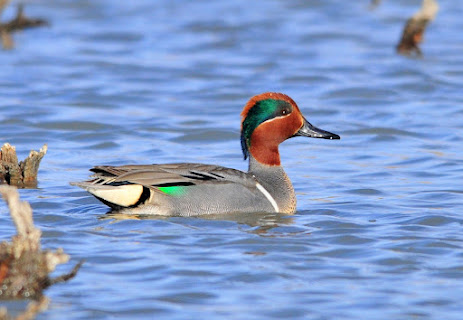
These ducks are little! Their length varies from 12.2-15.3 in, vs. a Mallard duck which are 19.7-25.6 in.
Green-winged Teals have closely spaced, comblike projections called lamellae around the inner edge of the bill, which they use to filter tiny invertebrates.
Here is the comic, by the way, that inspired my focus on ducks for this post. I highly recommend Rosemary's webcomic, called Bird and Moon. Check it out here. Also she has a very cute shop full of great presents for birders.